

From negotiated agreement to a clearer roadmap for market access
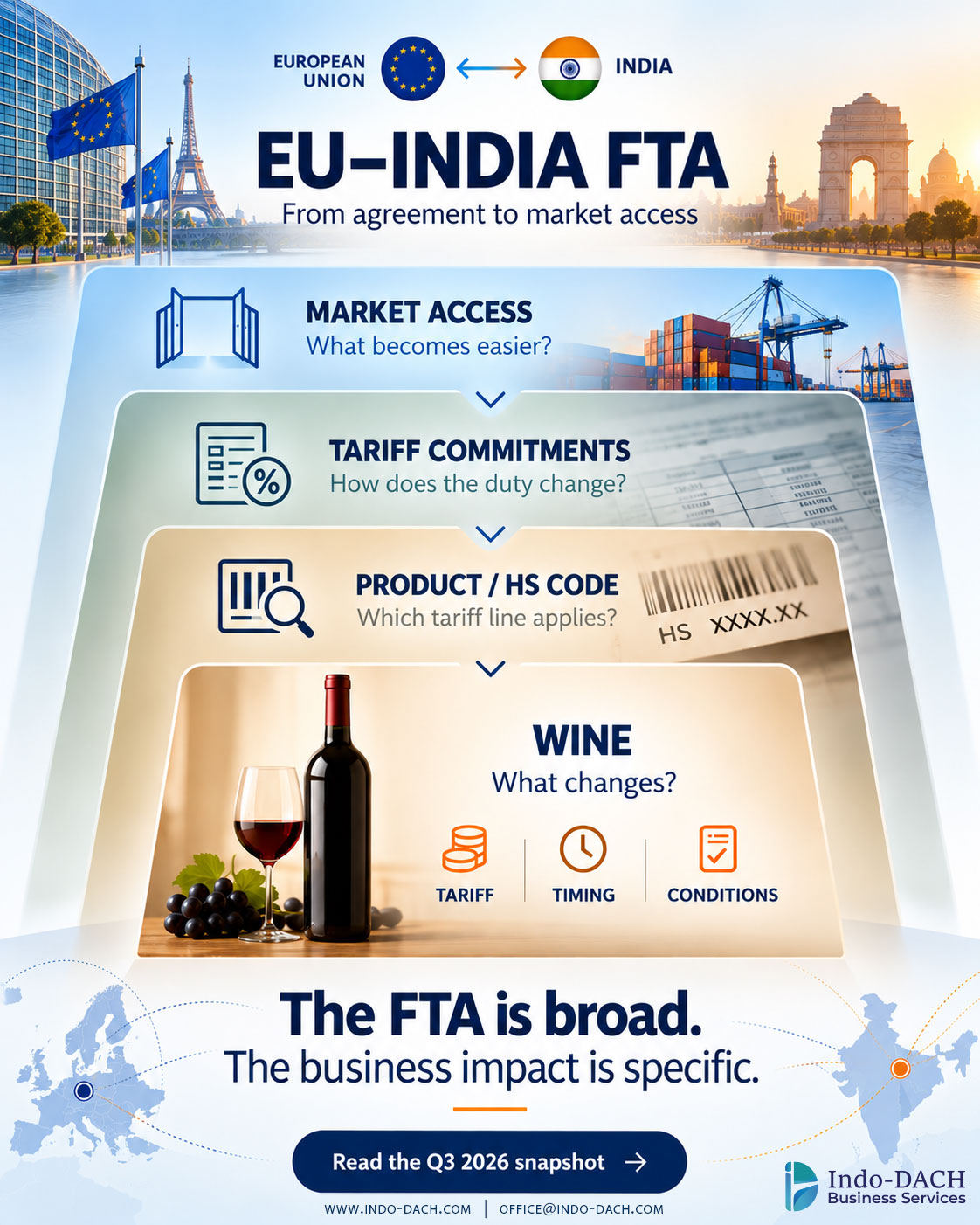
For companies doing business between India and Europe, the EU–India Free Trade Agreement has entered a new phase.
The negotiations concluded on 27 January 2026. In September, the European Commission published the negotiated agreement texts and detailed tariff schedules, following its proposal to the Council for the signature and conclusion of the agreement on 11 September. The Government of India has likewise published its Schedule of Tariff Commitments.
The agreement is not yet in force. The published European texts remain subject to legal revision and will become final upon signature. The agreement will become binding only after the EU and India complete their respective internal procedures.
Yet for businesses, the publication of the schedules is significant. For the first time, companies can begin looking beyond the headline announcement and ask a more practical question:
What could the agreement mean for my products, my costs and my market-access strategy?
Where does the EU–India FTA stand?
The journey can be simplified into five stages:
27 January 2026
Q3 2026
This distinction matters. A published tariff commitment is not the same as a tariff reduction that can already be claimed at customs.
For businesses, however, waiting for entry into force does not necessarily mean waiting to prepare. The published schedules provide visibility into the direction and timing of future market access.
Did you know that “tariff elimination” does not necessarily mean zero duty from Day One?
Under the EU–India FTA, different products follow different liberalisation schedules. Some tariffs are eliminated immediately, while others are reduced progressively over several years. Certain products are subject to tariff-rate quotas or other conditions.
This means that the relevant question for a company is not simply “Is my product covered by the FTA?” but “What tariff treatment does my specific HS code receive, and when?”
What has actually been published?
The European Commission has published the FTA text together with its chapters and annexes, covering areas including trade in goods, rules of origin, customs and trade facilitation, sanitary and phytosanitary measures, technical barriers to trade, services, digital trade, intellectual property, SMEs and sustainable development.
The Government of India has published its corresponding Schedule of Tariff Commitments.
These are substantial legal and technical documents. Most companies will not need to read them from beginning to end.
For a business assessing the agreement, the tariff schedule is an important starting point. It allows a company to identify its product, establish the current tariff treatment and examine how that treatment is expected to change over time.
That is where the FTA starts becoming commercially relevant.
What do the headline numbers tell us?
The European Commission estimates that the EU will eliminate tariffs on more than 90% of tariff lines, representing 91% in terms of tariff value. India will eliminate tariffs on 86% of tariff lines, representing 93% in terms of tariff value.
Both sides will also partially liberalise additional tariff lines. Taking full and partial liberalisation together, the overall coverage of trade liberalisation reaches 99.3% for the EU and 96.6% for India.
These figures need to be read carefully.
A tariff line is a specific customs classification, not simply a product category in everyday business language. And tariff elimination does not necessarily mean that the duty falls to zero on the first day the agreement enters into force. Some products have transition periods, while others are subject to quotas or specific conditions.
The headline therefore is not simply “tariffs disappear”. It is better understood as:
The agreement establishes a broad roadmap for progressively improving market access between the two economies.
How should a business read the tariff schedule?
For an individual company, the process is relatively straightforward in principle:
But there may be additional conditions along the way.
A product may receive an immediate tariff reduction, a phased reduction over several years, preferential treatment only within a tariff-rate quota, or no concession at all.
This is why the FTA should not be viewed as one single tariff cut. It is better thought of as a product-by-product market-access roadmap.
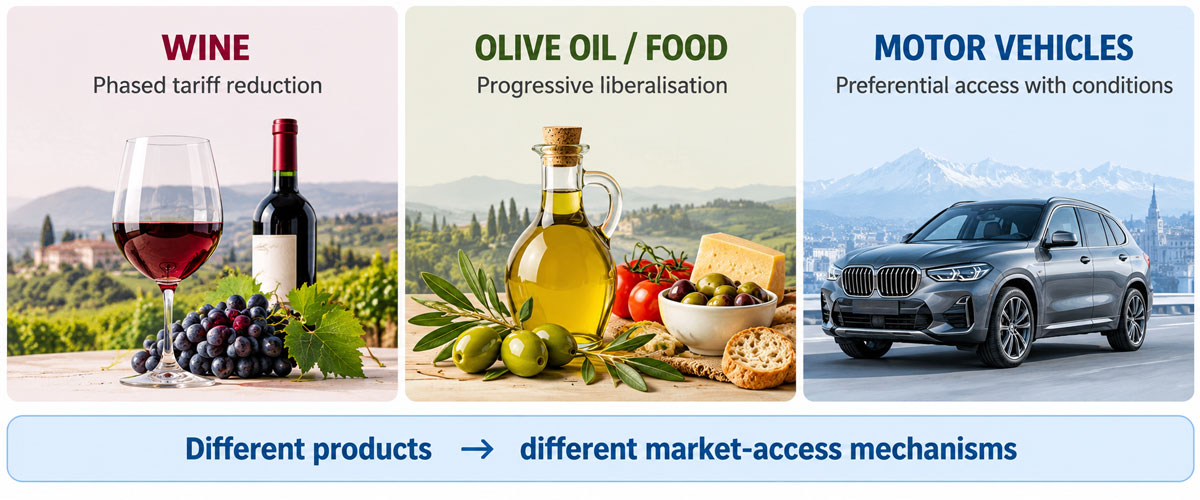
Three examples show how different the treatment can be
The EU–India FTA has not yet entered into force, but the publication of its detailed tariff schedules changes the business conversation. Companies can now move beyond broad expectations and begin assessing, product by product, how future tariffs, transition periods, quotas and rules of origin could affect their India–EU trade and market-entry decisions.
Wine: a phased reduction
Wine provides a useful illustration of a high tariff coming down over time. India's current tariff on wine can reach 150%. Under the agreement, the rate is reduced substantially, with future rates of 20% for premium wine and 30% for the medium range.
The important point is not the wine itself. It is the mechanism: a significant tariff reduction can still be phased and differentiated according to the product category.
Olive oil and processed food: moving towards zero
Some European agri-food products receive much more substantial liberalisation. Olive oil, for example, currently faces tariffs of up to 45%, while several processed food categories and products such as fruit juices are also subject to significant reductions, in some cases reaching zero.
This demonstrates another feature of the agreement: different sectors can have very different liberalisation paths.
Motor vehicles: access with conditions
Motor vehicles illustrate an even more structured approach. The agreement provides preferential access at a substantially lower tariff within a defined quota, rather than simply applying a zero tariff without limitation.
The lesson is important for companies:
An FTA benefit may depend on product classification, quantity, value, technology, timing or other conditions.
The same principle applies to tariff-rate quotas for certain agricultural products, where preferential treatment is available up to a specified quantity.
The tariff is only one part of market access
A lower customs duty does not automatically make a product competitive or even eligible for preferential treatment.
One of the most important accompanying elements is the Rules of Origin.
To claim preferential treatment, a product must satisfy the applicable origin requirements. In other words, it is not enough for goods simply to be shipped from India to Europe, or from Europe to India. Their origin must qualify under the agreement's rules.
Businesses also need to consider:
- customs procedures and documentation
- sanitary and phytosanitary requirements
- technical regulations and standards
- product-specific compliance
- services and digital trade provisions.
The FTA therefore extends considerably beyond customs duties. It contains 20 chapters covering goods, services, digital trade, intellectual property, SMEs, regulatory practices and sustainable development, among other areas.
For companies, the commercial question is ultimately broader than “What is the new tariff?”
It is: “What will it take to use the new market access effectively?”
What should businesses do now?
Companies trading between India and the EU do not need to wait for the FTA to enter into force before beginning their assessment.
A practical six-step review could start with:
1. Identify your HS codes
Make sure the products you trade are correctly classified.
2. Establish the current tariff
Understand the customs duty currently applicable to your products.
3. Check the negotiated treatment
Locate the relevant tariff line in the applicable FTA schedule.
4. Check the timeline
Determine whether the preferential treatment applies immediately or is phased over several years.
5. Check the conditions
Look for rules of origin, quotas, price thresholds and regulatory requirements.
6. Recalculate the business case
Assess what the change could mean for landed cost, pricing, sourcing, competitiveness and market-entry decisions.
For companies with significant India–EU trade, this exercise can also feed into longer-term decisions around manufacturing, sourcing and distribution. The European Commission's Access2Markets platform can be useful for this product-level work, bringing together information on tariffs, rules of origin, procedures and product requirements.
What happens next?
The next phase is largely about moving from the negotiated framework towards implementation.
The sequence will involve signature, legal finalisation, completion of the respective internal procedures and, eventually, entry into force. For businesses, this creates a useful window between knowing what has been negotiated and being able to use it commercially.
That window can be used to review product portfolios, identify relevant tariff lines, assess supply chains and understand where the agreement could alter the economics of doing business between India and Europe.
From agreement to opportunity
The EU–India FTA is not yet operational. But the publication of the agreement texts and tariff schedules represents an important change in the information available to businesses.
The broad direction is now clearer. Tariffs covering a large share of bilateral trade are expected to be eliminated or reduced, but the actual benefit will vary by product, tariff line, timing and conditions.
For an individual company, the most useful question is therefore not simply “What does the EU–India FTA offer?”
It is: “What does it mean for the products and markets that matter to us?”
That assessment can begin now.
The EU–India FTA is best understood as a roadmap for market access rather than a single tariff cut.
With the negotiated texts and tariff schedules now publicly available, businesses can begin identifying their relevant HS codes, understanding the future tariff treatment, checking Rules of Origin and assessing how the agreement could affect sourcing, pricing, competitiveness and market-entry decisions.
The agreement is not yet in force — but the preparation can begin now.
Sources & Useful Links
Primary sources
European Commission — EU–India Agreement Texts and Tariff Schedules
The principal EU source for the negotiated agreement, chapters, annexes and tariff commitments.
Text of the agreements - Trade and Economic Security - European Commission
European Commission — EU–India FTA Chapter-by-Chapter Summary
Useful for understanding the agreement beyond tariffs, including goods, services, digital trade, rules of origin, SMEs and sustainability.
MEMO: EU-India Free Trade Agreement: Chapter-by-Chapter Summary - Trade and Economic Security
Government of India — Schedule of Tariff Commitments
The Indian government's published tariff schedule for the agreement.
2. India - EU FTA — Annex 2A and EU Goods Schedule part 1.pdf
Business-oriented resources
Federation of European Business in India (FEBI) — EU–India FTA Resources
A useful business-oriented collection of information and analysis on the agreement.
European Commission — Access2Markets
Useful for companies wanting to investigate tariffs, Rules of Origin, import procedures, product requirements and other market-access information for individual products.
Disclaimer
This article is intended for general business information and educational purposes only. It is based on publicly available information on the EU–India Free Trade Agreement and its published tariff schedules as available at the time of publication. The agreement remains subject to the applicable signature, legal finalisation and internal approval procedures and is not yet in force. Tariff treatment, Rules of Origin and other market-access conditions may vary by product and HS code. Companies should consult the official agreement documents and obtain appropriate customs, legal or trade advice before making commercial decisions.